Showing posts with label ACTION. Show all posts

Sunday, December 18, 2011

Bus advertising bus advertising

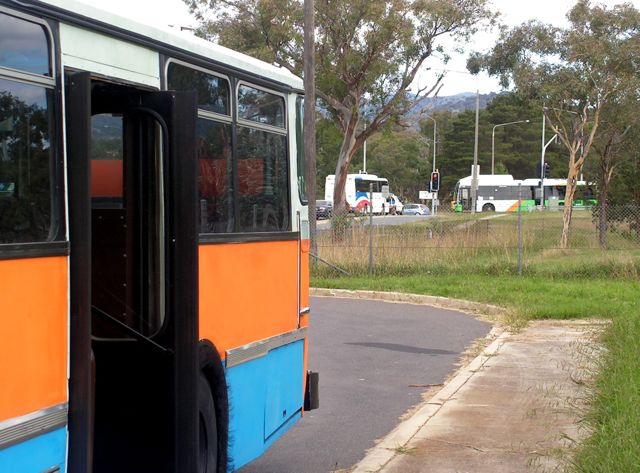
Like most public transport operators, ACTION buses rent the sides of their vehicles for advertising, and a recent ad caught my eye. It was a bus advertising bus advertising. 
ACTION bus

A few days later Daniel Bowen, President of the Victorian Public Transport Users Association, posted an item on his blog on 'Symmetry and recursion' in public transport advertising in Melbourne. So, I emailed him the photo above - and he replied, attaching the picture below!

Tuesday, October 18, 2011

Bus-ness as usual: draft 'Transport for Canberra' policy released

Last week the ACT Government released its draft ‘Transport for Canberra’ policy plan and it is underwhelming.  The ACT Government is pursuing a medium to high density housing strategy, and using the ‘public transport, ‘transit route’ etc reasoning to justify it. The policy has no funding models attached to it and states several times that buses are the future for Canberra’s public transport. Where light rail is mentioned, it is scant, and promises a ‘study’. Not once is the Infrastructure Australia bid for light rail funding from only two years ago mentioned.

The draft policy plan discusses openly the aim that medium and high density housing will be built along ‘transit corridors’ which means bus routes. By encouraging medium and high density housing, without providing the proper public transport to support it, Canberra will experience all the disadvantages of high density housing, and none of the advantages.

Aiming low and redefining success

Sadly, the draft transport policy, which is meant to guide ACT transport planning until 2031, aims low. The percentage of people the ACT government predict will use public transport in 2031 is 16%. Up from what they claim is 9% right now. That’s an amazingly low target. By failing to deliver a world class mass transit system in the form of light rail, our government is content to allow Canberra to continue as a car-centric, increasingly congested city. Our nations capital deserves better.

On page 22 of the draft policy they say:
“The government has committed to increasing the public transport share of all work trips to 9 per cent by 2011, 12 percent by 2016, and 16 per cent by 2026”

By focussing on ‘work trips’ this allows the policy makers to ignore the following members of our society: school children, the aged, stay at home parents using public transport during the day and others. This tricky language doesn’t fool anyone. Public transport is not just satisfying peak hour commuting, it is a social obligation.

Page 6 of the draft policy has an interesting graph. The ACT Government forecast that in 2026 there will be 277,000 jobs – and that only 80,000 of these workers will choose public and active transport.

In the draft policy plan, they also see ‘active transport’ (walking and cycling) growing to 14%. The Canberra Times reports:

Minister for the Environment Simon Corbell launched the plan yesterday at Belconnen bus interchange, saying he wanted 30 per cent of Canberra journeys to work to be taken by sustainable transport, foot, bicycle or public transport, by 2026.

In the draft policy a table supporting this aim appears on page 54:

By aiming this low, it means that in 2031, our half million residents of a compact city of high density housing will still see 70 people in every 100 driving to work. As our population is expected to rise from 330,000 in 2011, that is not less reliance on cars, that is MORE cars. Very sustainable.

Minister Corbell also redefines success, and promises less services for people in Canberra’s suburbs. It is accepted wisdom among transport planners that to increase patronage you must offer frequent, reliable and attractive public transport. What does Minister Corbell announce:

'There will be a frequency of 15 minutes or less on the rapid and frequent service corridors, new guarantees about how long people have to wait to interchange.''
The plan calls for ''coverage'' service that feeds into the ''frequent network'' and ensures every home would be within 500m of a service of at least 60-minute frequency, putting a regular bus route within a short walk of every home in Canberra.

Yes, people waiting for a bus in Amaroo to connect them to a 15 minute service will have to wait up to an hour for a local service.

Simply put – a once an hour bus service will not attract commuters to public transport.

By contrast, ACT Light Rail propose building light rail as a mass transit backbone and increasing local service frequency for buses connecting to local transport nodes (such as park and rides) to a 20 minute frequency.

The same Canberra Times article also discusses light rail:

He said that a ''business as usual approach'' to Canberra's transport mix would result in a doubling of congestion on the city's roads by 2031 and pledged to continue to study the possibility of light rail on major road corridors.

Yet another study into light rail

Yes, what Canberra needs is yet another study into light rail. This study comes less than two years after the ACT Governments submission to Infrastructure Australia asking for federal funding for light rail. The light rail bid that was at that time the leading bid. Where the Chief Ministers media release stated 'Stanhope lists light rail as ACT Priority for Commonwealth infrastructure funding'.

The only bid from that exercise that our local politicians pursued with any vigour was the bid for more road funding to build Majura parkway.

As the new study will show, light rail has several advantages over buses including higher passenger capacity per vehicle (and driver), lower cost over total life, greater passenger comfort, reduced journey times (over buses on roads), less energy per passenger kilometre and provides investment certainty along transport corridors because of infrastructure commitment. In addition, light rail improves property values, and increases rental and retail income. These factors appeal to property developers who have demonstrated globally their willingness to invest in Transit Oriented Development along light rail routes.

Bus-ness as usual

It is crystal clear from reading this draft ‘Transport for Canberra’ policy that this government sees Canberra’s transport future as cars and buses. It is ‘Bus-ness as usual’. This does not come as a surprise. By pursuing this bus-only public transport strategy, the public transport patronage figure will only rise by a small amount. If the ACT Government truly want to bring about a medium to high density ‘compact city’, they need to plan proper mass transit using light rail, and then encourage Transit Oriented Development. Not only will the proposed bus only plan fail to deliver transit oriented development, it will fail to attract increased patronage.

ACTION buses are being asked to do two things – act as a mass transit intertown service using limited capacity buses (requiring more and more of them) and serve as a local area coverage feeding the intertown services.

ACT Light Rail suggests that light rail provide the mass transit backbone, and ACTIONs fleet is retasked to provide a higher frequency local area service. This makes best use of the advantages of both transport technologies. The greater carrying capacity and higher speed of light rail, and the flexibility of buses to serve new areas and routes and pass within 500 metres of resident’s homes.

Although it may appear that light rail is dealt with casually in this new transport policy, at least it is being discussed. Compared to the 2004 Sustainable Transport Plan – which claimed buses could deliver all the benefits of light rail – this Transport Plan now discusses light rail. ACT Light Rail would like to take some credit for that, but we aren’t the only group that have been telling the ACT Government that buses, and continued reliance upon them for mass transit – wont work. It is a message that the general public has delivered, through numerous polls, and also at the Time to Talk exercise.

It was obvious at the ‘Time to talk’ public consultation sessions that the public are aware that light rail is required. That process was very focussed on planting a meme that medium and high density was OK, and that we needed to convince people to believe that. ACT Light Rail do not have a position on urban densities, but light rail will provide a true magnet for transit oriented development. This is something the government talks up, but will find that it can’t attract by relying on bus routes. 

Why light rail can deliver TOD and buses cannot

Fixed rails bring investment. This is proved time and time again especially in US based urban renewal where light rail has been introduced. The only transit oriented development that bus rapid transit brings is at the site of the actual bus stations. It does not lead to transit oriented development along the bus routes.

It is positive that the Draft report talks about light rail in several places, it shows that the ACT Government now realise the benefits that light rail can deliver - although they still talk up bus rapid transit (BRT). Take page 27, section 2.4 for example:

The 2031 network has been designed for the current bus-based fleet, but will be adaptable to and supportive of mass public transport technology like light rail, bus rapid transit, monorails or other technology. To help plan for mass public transport, we will focus on defining the Frequent Network in policy and planning so other city-building activities can respond to it.

Its clear from reading the entire document that buses are the ONLY mode this government are planning on. By mentioning monorails it really cheapens the credibility of the document. The authors would be well aware that there are no monorail systems anywhere in the world, or even any in planning, that are used as mass transit public transport systems.

Where is the vision?

Overall it is disappointing that the report, while very densely stocked with positive goals and aspirational objectives, lacks a clear vision (focussing solely on the public transport aspect).  Active transport is a great thing to encourage but there are several problems with it. In winter cycling rates plummet, and by closing local schools and centralising super schools, the opportunity for children to walk or ride to school declines, and the requirement for parents to drop kids off to school, and then drive to work increases.

The increased residential density in the Inner north is also leading to a rising rate in ‘active transport’ i.e. – walking, not through any ACT Government policy, but because it is putting homes closer to peoples workplaces.

Just as this years Infrastructure Plan didn’t really have any single vision for public transport, this plan is the same. Piecemeal bus priority lanes added to roads which surge with traffic from new developments in Molonglo will continue for the life of this plan. A suspicious person could think that this is really more road spending hidden as bus transit way spending – although there are no funding figures associated with the report at all.

What the plan also fails to understand is that for a true shift to public transport there needs to be a modal shift. Buses will not provide the shift. The graph on P.62 of the draft policy would have us believe that there will be 16% of people using PT in 2026! That’s an amazingly low target. Why is it low? Because the ACT Government knows that by continuing to rely on buses, PT patronage will not grow. 

How can the ACT Government increase public transport patronage and grow our city in a sustainable way?

If the ACT Government provided a proper public transport system using a mass transit technology like light rail as its backbone, the percentage of workers or other residents would rise above 20%. It would then continue to rise as transit oriented development grew along the light rail routes, feeding more commuters into the system and establishing public transport use as an ingrained value. By providing a viable alternative to the private car, many families could shift from being two car families to single car families – saving an estimated $10,000 a year (NRMA figure). Active transport would also grow as people are able to more easily take bicycles on light rail vehicles, and will be more open to walking.

No money for public transport infrastructure

The draft policy plan also fails to commit to any real public transport infrastructure funding. After a sell off of buses in 2006, the government has been rebuilding the bus fleet and building piecemeal bus lanes on existing road – these bus lanes are referred to by this government as ‘transit ways’. 

In a 'Bus News' article , the Minister was quoted as saying:

“The policy provides options that support growth of the ACT economy by creating a safer, more efficient and more sustainable transport system, with ring road options for cars and freight, and public transport corridors for people,” he says.
"The ACT Government has already invested more than $1 billion in the transport system in the past 10 years, with over $120m committed in the 2010-11 and 2011-12 Budgets to roll out Transport for Canberra projects.”

Sadly this money is not going to build an initial light rail route in the ACT, or even bus rapid transit. It is the normal ongoing spending associated with the ACTION fleet, and incremental bus lanes. And of course more roads.

Conclusions from the draft policy

Although the draft ‘Transport for Canberra’ policy plan is underwhelming in its vision and aims, it does contain some positive aspects. Light rail is at last discussed positively in a strategic policy plan coming out of the ACT bureaucracy. The ACT also desperately needs a clear plan for its existing bus network.

One should not dismiss the tremendous amount of progress that has been made in recent years – especially with the introduction of the Red and Blue Rapid and Expresso bus services. These are good examples of smart transport planning. It is hoped that they lead to an increase over the longer term of bus patronage.

“IF” the public transport trip percentage hits 16% that would be the best argument for light rail – as ACTIONs fleet will be bursting at the seams. It is already at capacity on some routes. Buses out of Gungahlin in 2011 are so crowded during peaks that they have to drive past commuters waiting at stops.
“If “the 16% target were achieved, this would mean that the ACTION fleet would have to double. That is twice the amount of drivers and twice the amount of buses, mainly to serve the peaks. It is more logical to build light rail – and use the increased passenger carrying capacity and decreased staffing, that would bring. The highest cost of public transport (after infrastructure provision) is ongoing staffing.

So to sum up:

Positives:
  • Report actually discusses light rail as an alternative to bus rapid transit
  • Has a plan to expand the bus network (although I’m doubtful it will actually increase patronage)

Negatives:
  • Heavy on motherhood statements
  • Light on empirical data to allow us to reach our own conclusions
  • Yet another ‘light rail study’
  • Sets low goals.
  • No clear vision.
  • No plan to provide a proper mass transit system (even BRT)
  • No mention of funding (doubling the number of buses and bus drivers wont be cheap).
  • ACT Government see Canberra’s transport future as cars and buses.
  • Guarantees a continuing car culture.
  • Will see more road congestion.
ACT Light Rail will be putting in a submission on the draft ‘Transport for Canberra’ policy plan. We welcome your feedback. Our submission will be lodged before the November 11 date, so any input must be received at least a week prior to that closing date. 

ACTION - by Royal Appointment.

HRH Prince Charles

I was at the RATEC clubhouse some months ago and came across this interesting photo. As the young fellows mother is visiting Canberra this week, I thought I would post it. 

I'd really like to know which bus he rode on. That would be a bus for ACTION to preserve (if it hasn't already gone to the crusher). Sadly, I don't even know the date that the photo was taken. It looks like the 70's though. He is wearing a hard hat, so it could even be a depot tour. 

If anyone can supply more information (or photos) please leave a comment or contact me. 

Wednesday, March 30, 2011

ACTBUS take ex-ACTION Bus 670 around Canberra

ACTBUS is a local internet forum where matters pertaining to the ACT Bus network, its fleet, stops, livery, employees, public perceptions, local supermarkets, locations of fast food outlets, digital TV reception etc are discussed and archived. They also have an extensive gallery of pictures of buses that have been in ACTIONS fleet over the years.

They also hold a few social activities, and the tour of Canberra's bus related sites on a bus is probably the highlight of the ACTBUS social calendar. It was particularly appealing this year as it was to be on an ACTION drivers personal bus, an ex-ACTION Mercedes he bought from Sydney after it was retired from service. He is currently restoring it with the assistance of several enthusiastic gunzels. They have done a pretty good job so far, with an ACTION livery applied sans ACTION graphics. They have even obtained an old ACTION destination roll, correct to the period of the bus. It is registered, insured and ready to roll.
At 1PM on Sat 26th of March,  ex-ACTION 670 arrived at Platform 5 of the Belconnen Community Station to collect an assortment of retired ACTION employees, members of ACTBUS, a few current ACTION drivers and me.  

There was a list of people that had indicated they would be attending, and the money to cover costs was collected ($10)  and names ticked off. The bus set off at about 1.15Pm to Civic where it was to collect a few more people. Just before leaving Belconnen, an ACTION supervisor advised us to be careful as there had been reports of teenagers throwing rocks at buses from a bridge. Im pretty sure we didn't get attacked during the day. 

It was certainly odd traveling on the bus and chatting to the gunzels. They were very well informed on all the peculiarities of the various buses in ACTIONS fleet, the dogs, the good ones and the decisions made to purchase various buses. I think if the various consultants that the ACT Government hire to give them advice on planning Canberras public transport spent a few hours with these people - they would learn some very valuable things.
After leaving Civic, 670 then headed off to the Woden interchange to collect the last gunzels. At Woden it was realised that 670 had left ten minutes early from Civic, and should they go back and see if anyone else had turned up? As all those who had RSVP'd were on board the decision was no. 
Naturally one of them had loaded MyBus on their smartphone. It was fun to fiddle with, but as ACTION wont allow certain data to be made public, functionality was fairly limited. It is good to be able to look at your bus routes timetable. 

Discussion then turned to availability of timetable info from a specific bus stop. It exists, but ACTION wont release that either. Solution - photograph your bus stops timetable on the plastic timetable display on the pole (if its displayed) and keep it on your phone. Its clear that real-time data  can be very useful for people planning a trip using ACTION, and that data should be accessible by a smartphone. 
The tour detoured into the Tuggeranong depot for a few laps around while we snapped photos from the window. Sadly, we didn't stop and alight to take photos. I guess ACTION dont want gunzels racing around their depot on the weekend. 
 Glad to see ACTION employees embracing active transport. 
 Excellent use of a bus stop
 'Ed' performing driving duties for part of the tour.
After leaving Tuggeranong we shadowed an actual ACTION bus on part of its route. You could see very quizzical looks on peoples faces that were waiting at the bus stops as two ACTION buses appeared to be arriving - on a Saturday afternoon. 
We stopped at several ex-terminus's (termini?) at Theodore and Conder Red Hill where all infrastructure had been removed. We would be regaled about the history of the location, the routes that it served, when it operated etc. Trust me - this is interesting stuff.  Many photos were taken, of buses, bus signs, bus stops, concrete pads where things used to be, etc. 
 Obviously easier to leave your ride home where you can access it upon your return.
 The restoration job so far has been pretty good. 
The rear of the bus was opened several times, for photos and also because it got pretty hot on a few occasions, such as the trip up Red Hill and around some of Tuggeranongs more hilly areas.
The destination roll was changed numerous times during the day. People were snapping various vintage locations such as 'Canberry Fair 'etc. You may notice on one of the other photos a location called 'Condor'. 
I didn't do a head count, but there was at least 30 people on board during the day.  At least three were current ACTION drivers, who swapped driving duties at most stops. The onboard division seemed to be retired ACTION up the front, gunzels down the back. 
 Three buses in this photo in Red Hill/Narrabundah.
There are quite a few 'historic' bus stops around Canberra, which you realise when they are pointed out to you. Quite a few are no longer on actual ACTION routes any more. This one in Forrest. We even saw locals taking photos, either of the old ACTION bus or the odd gents (and they were all gents) standing around with cameras taking photos of an old bus. 
After a tour around Narrabundah and Red Hill, we headed up to the Red Hill lookout for photo opportunities. Breathtaking views from up there, although a coke and cake from the cafe set me back ten bucks. And it was a 200ml bottle...
 The bus was carefully backed into the kerb so that a group photo could be taken.
The group photo. I stole this photo from the ACTBUS forums. Chris, the bus owner is third from right. 
After leaving the Red Hill lookout, 670 headed down to the Old Bus Depot in Kingston, which is now a weekend market and artsy crafty precinct. Historically, 670 shouldn't have gone there as this bus probably never set tyre in the depot, according to some of the gunzels - being too new apparently. Still, it was a good photo opportunity.


Update from Martin670 didn’t spend time at Kingston Depot although not because it was too young. Its class mates 650 to 666 (or something like that) were allocated to Kingston and moved out when Kingston was closed.
We then left the old Kingston Depot and headed for the National Gallery , and a stop for photos. We then toured around the lake in front of Reconciliation Place and then up to Old Parliament House. Quite a few gunzels got out to take photos of the tent embassy, and Martin took over driving duties, heading around the back of Old Parliament House so 670 could do a few passes in front of it for photo opportunities. 
Confused ACTION patron attempting to board 670

670 then headed to Civic across the lake and arrived in the Civic interchange around 5 PMish. There were lots of people standing around waiting for buses (I think there was a rugby match on) so 670 pulled up at Platform 5 (near Northbourne) and I got off. The bus was heading off for more gunzel sightseeing, night time photo opportunities and a dinner in Dickson, but I had a prior engagement (her name was Kristina Kenneally) so I bade farewell. 

This was the second time I had been on this tour, and it was certainly a lot of fun. Last year several ACTION buses were chartered, but using a historic vehicle this year was a stroke of genius. It was also great to meet the members of the ACTBUS forum, gunzelling is a fairly solo activity and ACTBUS is a loci for their interests so they dont really meet each other in the flesh all that often. 

My thanks to all involved in organising this trip. It was great fun. 

If you have an interest in the public transport network in Canberra, I recommend visiting the ACTBUS forum and joining in or just lurking and reading the phenomenal amount of information they have compiled on the Canberra ACTION network and its fleet of machines.